

Some evenings the eyes are tired but the heart is not. That is not a modern problem. Bengali poetry was spoken aloud for centuries before it settled onto the printed page, carried by reciters at village gatherings, school functions and family evenings. An audio app is only the newest room for a very old habit. When reading feels like too much, listening is not the shortcut. It is the original road in.
Whose voices fill the collection
Before choosing how to listen, it helps to know what there is to hear. Our own collection at KobitaGhar holds 2,179 works by 26 poets, and the shape of it explains what any listening habit will actually sound like.
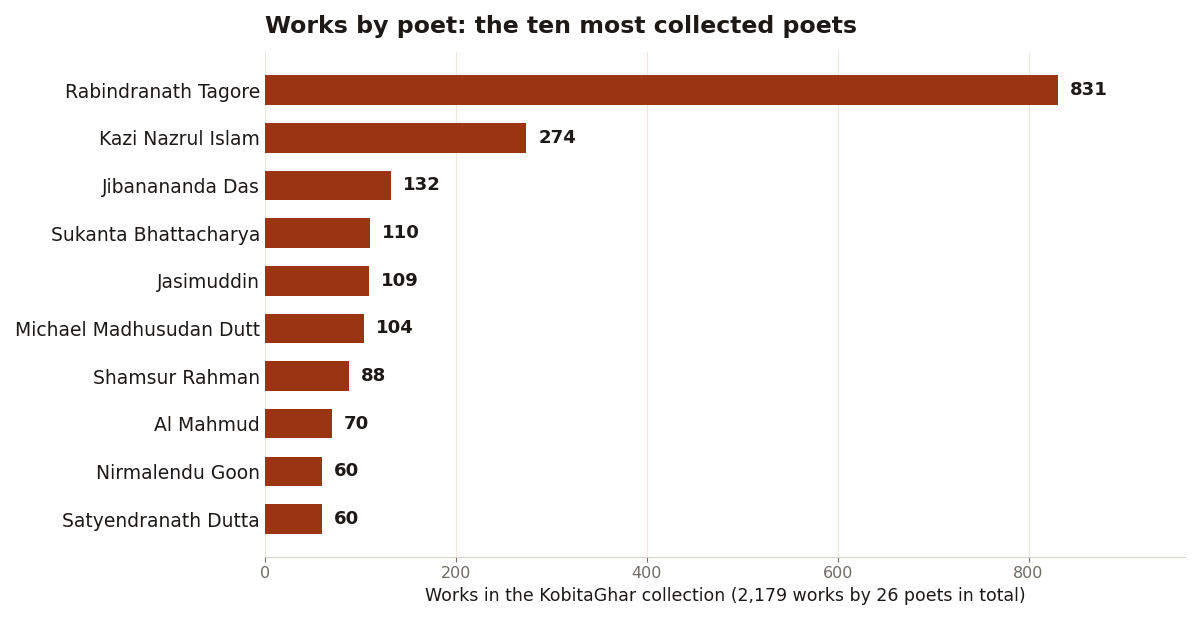
Tagore is the weather of this collection: 831 works, more than a third of everything we hold. Nazrul follows with 274, then Jibanananda Das with 132. The ten most collected poets account for 1,838 of the 2,179 works, about 84 percent, which means a listener who rotates through just those ten voices still covers most of the Bengali canon. Full text is on file for 1,437 of the works, so for most of the collection you can follow the words on screen while a reciter carries them, the way a generation learned from radio with a book open on the lap.
Five ways to listen well
1. Recitation albums: Bratati Bandyopadhyay has over 60 albums covering Tagore, Nazrul, Sukumar Ray, and Shankha Ghosh. Her diction is a classroom.
2. YouTube abritti channels: full recitations, free, searchable by poem name. "Keu Kotha Rakheni" alone has dozens of renditions, and hearing three voices read the same lines teaches more than reading them three times.
3. Radio archives: the old Kolkata radio recitations still circulate online. The veterans knew breath control, and their pauses are a masterclass.
4. App libraries: poem text and voice together, the thing premium poetry apps are building next. Start with the poets the chart puts at the top, then wander down the long tail of the other sixteen.
5. The bedtime rule: one poem, lights low, phone face down. Audio poetry is the original podcast, and one poem heard properly beats an hour of half-heard scrolling.
The long tail is worth the walk
The chart stops at ten poets, but the collection does not. The other sixteen poets hold 341 works between them, and some of the best listening lives there. Sukumar Ray has 53 works in the collection, and his nonsense verse read aloud is a different pleasure entirely: rhythm first, meaning chasing behind. Sunil Gangopadhyay holds 52, Farrukh Ahmad 50 and Joy Goswami 48, three voices that carry the language from the last century into this one. Shamsur Rahman, with 88 works, is the sound of Dhaka itself for many listeners.
A simple way to structure a listening week: give the mornings to the top of the chart and the evenings to the long tail. Tagore and Nazrul carry the canon, but a reciter's take on Sukumar Ray or Joy Goswami will surprise you in a way the hundredth hearing of a famous poem cannot. Because full text is on file for 1,437 of the 2,179 works, you can follow along for most of the tail as well, and the poems without full text are a reminder to listen twice: once for the sound, once for the sense.
One more honest note about audio: a recitation is an interpretation. The same poem in two voices is two poems. When an app or a channel gives you the same title by different reciters, that is not duplication. That is the good stuff.
Keep the line that stopped you
Listening has one weakness: the line that lands has nowhere to go. Fix that with the site's free Kobita Card Maker. When a recitation gives you two lines you want to keep, paste them into the card maker, set them over a clean background, and save the card to your phone or send it to the family chat. A heard poem becomes a kept poem, and kept poems are the ones you end up knowing by heart.
Listening is not cheating. Bengali poetry was spoken before it was printed, and a poem heard is remembered twice as long as a poem skimmed. Sources: Banglapedia. Tonight, pick one voice from the top of that chart, press play, and let the eyes rest.