

Free poetry apps are real and useful, and so are paid ones. The honest question is not which is better in the abstract. It is what your money actually buys, and what it cannot. To answer the second half, it helps to know what the poems themselves look like when you count them, because an app is only ever a door into a collection.
The canon, counted
Our KobitaGhar collection holds 2,179 works by 26 poets, and every work carries theme tags from our cataloguing. Counted by theme, the canon is wider than most people expect.
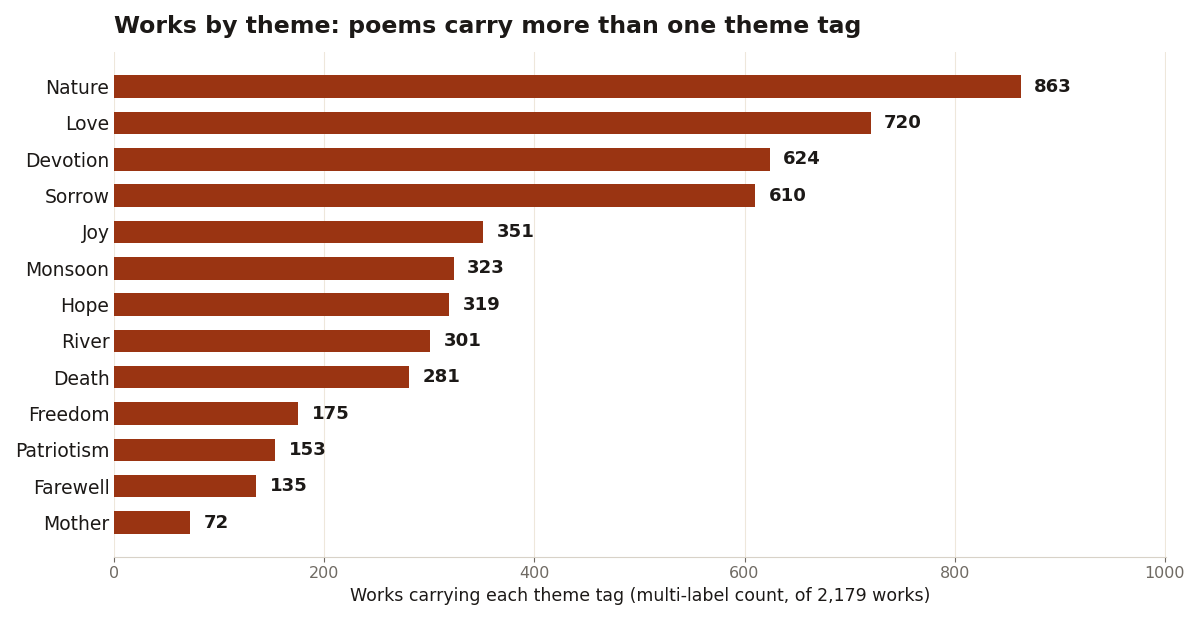
Nature leads with 863 tagged works. Love follows at 720, devotion at 624 and sorrow at 610. Even the smallest shelf, poems tagged for mothers, holds 72. This is the test to apply to any app, free or paid: does it open onto a range like this, or does it recycle the same twenty famous pieces? A door is worth paying for only when there is a house behind it.
What free gives you
1. Static poem lists, usually with ads between stanzas.
2. No offline mode. No signal, no poetry.
3. No audio. Reading only; recitations live elsewhere.
4. No sync. New phone, favorites gone.
For a reader who opens a poem twice a month, that may honestly be enough. Free tiers are where most people should start, and the good ones carry real Tagore and real Nazrul, not filler.
What paying gives you
Paying (around $4.99/month) gives you:
1. No ads. Poetry and advertising were never friends.
2. Offline library. Poems on a plane, on a village bus, anywhere.
3. Recitation audio. Abritti recordings, text and voice together.
4. Sync across devices. Favorites follow you from phone to phone.
Notice what is on that list: comfort, not content. You are paying for the experience around the poems. That is a fair trade for a daily reader and a poor one for an occasional one.
Run this audit before you pay anyone
You can test an app's depth in five minutes, using the same counts we ran on our own collection. First, count the poets. Our shelves hold 26, from Michael Madhusudan Dutt in the 19th century to living contemporary voices. An app with three poets is a pamphlet, whatever it charges. Second, count the themes. We tag 13, and the smallest shelf still holds 72 poems. An app that only stocks love poems and patriotic poems is a greeting card, not a library.
Third, check the text itself. In our collection, full text is on file for 1,437 of 2,179 works, about two thirds. The rest are catalogued titles, because copyright and sourcing decide what a responsible archive can print in full. Any app that claims every poem ever written, complete, is claiming something no honest archive claims. Fourth, look at the balance. Tagore is 831 of our 2,179 works. A Tagore-heavy collection is natural, he earned it, but an app where one poet is 95 percent of the stock is a single-author reader wearing a library's clothes.
Run those four counts on the free version first. If the free tier already shows depth, the paid tier is probably honest comfort: no ads, offline reading, audio, sync. If the free tier is thin, paying will not thicken it. It will only remove the ads from the thinness.
One last signal is how an app treats the poets it does not have. Our own cataloguing leaves gaps on purpose: some works are listed by title only while sourcing continues, and some poets of the last century are represented by a handful of pieces rather than their full output. An honest app admits the same about itself. A store page that promises the complete works of every Bengali poet, forever, for one small fee, is selling you a number it invented.
What money cannot buy
What paying does not give you: better taste. A free app with Tagore beats a paid app with filler. Pay for the experience around the poems, never for the poems themselves. The poems belong to everyone.
And the sharing part of the habit costs nothing at all. Our free Kobita Card Maker turns any two lines from your app into a clean image card for Facebook or WhatsApp, which is how most poems actually travel these days. Sources: Banglapedia. Start free, count what the app really holds, and pay only when the door is the thing slowing you down.