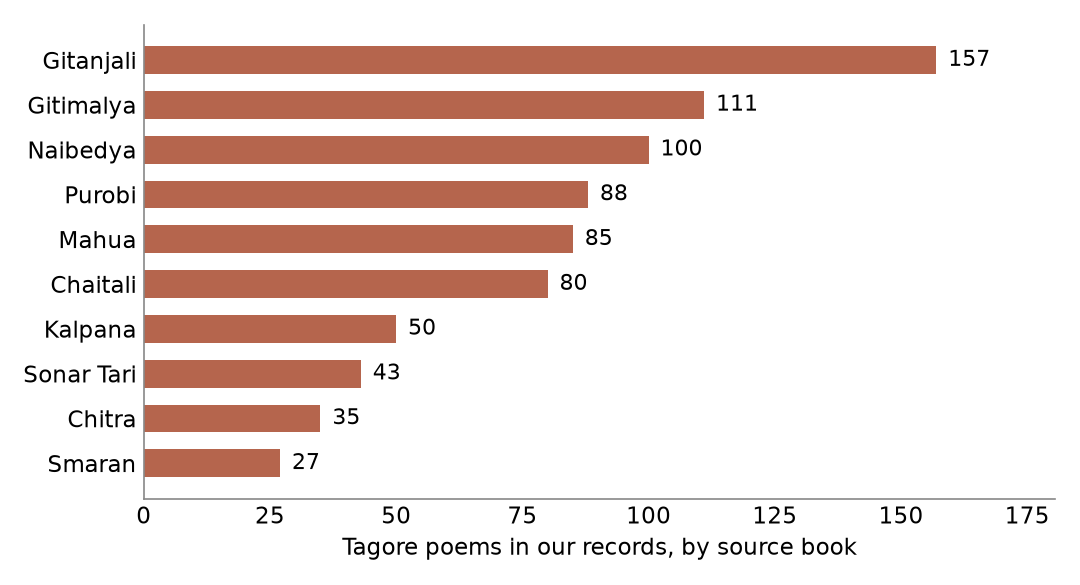
An author page, the form Wikisource uses for Tagore, organizes a poet by his books. Our catalogue does the same thing from the other side: it holds 831 Tagore poems, and every record names the collection it came from. Counted by book, the 831 spread across 16 collections, and three of them hold nearly half the poems we have.
The books, counted
| Collection | Poems in our records |
|---|---|
| Gitanjali | 157 |
| Gitimalya | 111 |
| Naibedya | 100 |
| Purobi | 88 |
| Mahua | 85 |
| Chaitali | 80 |
| Kalpana | 50 |
| Sonar Tari | 43 |
| Chitra | 35 |
| Smaran | 27 |
The top ten books hold 776 of the 831 poems, 93 percent. The shape matches how the poems are themed in our records: across his 831, love tags 439, nature 409, devotion 409 and monsoon 284, and the three song-and-offering books at the top, Gitanjali, Gitimalya and Naibedya, are where the devotional weight sits. A beginner does not need this map, and this blog's starting guides deliberately skip it. A reader on their second year of Tagore does: the books are the difference between reading Tagore the anthology figure and Tagore the working poet, who published in collections with their own moods.
The bottom of the table makes the same point from the other end. The six collections outside the top ten hold 55 poems between them, fewer than Gitanjali alone holds at 157. Anthologies keep reprinting the big three song books, so the 55 are the least-read Tagore in our records, not because they are minor but because the shelf space ran out. A counted catalogue is the one place they stand in a row with the famous books, same type, same table, waiting to be picked up.
How to use the map
Pick the book by the mood the counts expose. Devotion and offering: Naibedya and Gitanjali. The river-and-harvest Tagore: Sonar Tari and Chaitali. The late, spare voice: Purobi. And if a single poem from any of them follows you around for a day, that is the one to put on a card and send; it is what the Kobita Card Maker is for.
Sources: KobitaGhar poem catalogue, 2,179 records verified September 2026 (831 Tagore records). Author-page form follows bn.wikisource.org, Author: Rabindranath Tagore.