Tomorrow is the last day. The Bangladesh National Museum’s special Nazrul Year exhibition, Gahi Samyer Gaan (I Sing the Song of Equality), closes on October 31, 2026, after a short run in the Nalini Kanta Bhattasali Gallery in Dhaka. If you can still go, go: it is a strange and moving room, holding 96 artefacts that belonged to Kazi Nazrul Islam or remember him, among them his sweater, his plates, the bed he slept on, framed photographs, and the citizenship certificate, the nagarik prottoyon potro, that the government of Bangladesh issued him in 1976, the year he died. A documentary about his life plays in one corner. What the room cannot hand you is the poetry itself, and measuring that gap is something this site is unusually able to do.
A year for the poet, a room for the man
The government has designated May 25, 2026 to May 25, 2027 as Nazrul Year, honouring the national poet of Bangladesh (1899 to 1976), and the museum exhibition is the observance’s most tangible stop so far. Seventy-eight of the 96 objects come from the museum’s own collection; the other 18 are rare items brought in from elsewhere. The everyday equipment of a life is laid out with care: clothing, a razor, a brush, towels, a timeline on the wall, a sculpture in the hall. It is worth remembering whose life this was. Nazrul wrote at extraordinary speed for just over two decades, and then, from 1942, illness took his voice and his memory, and the loudest poet in Bengal spent his last thirty years in silence. Coverage of the exhibition makes a fair point about the room: for a poet whose legacy rests on his writing, it holds surprisingly few handwritten pages. The objects prove the life happened. The work, as always with Nazrul, is somewhere else.
274 poems on record, and what on record means
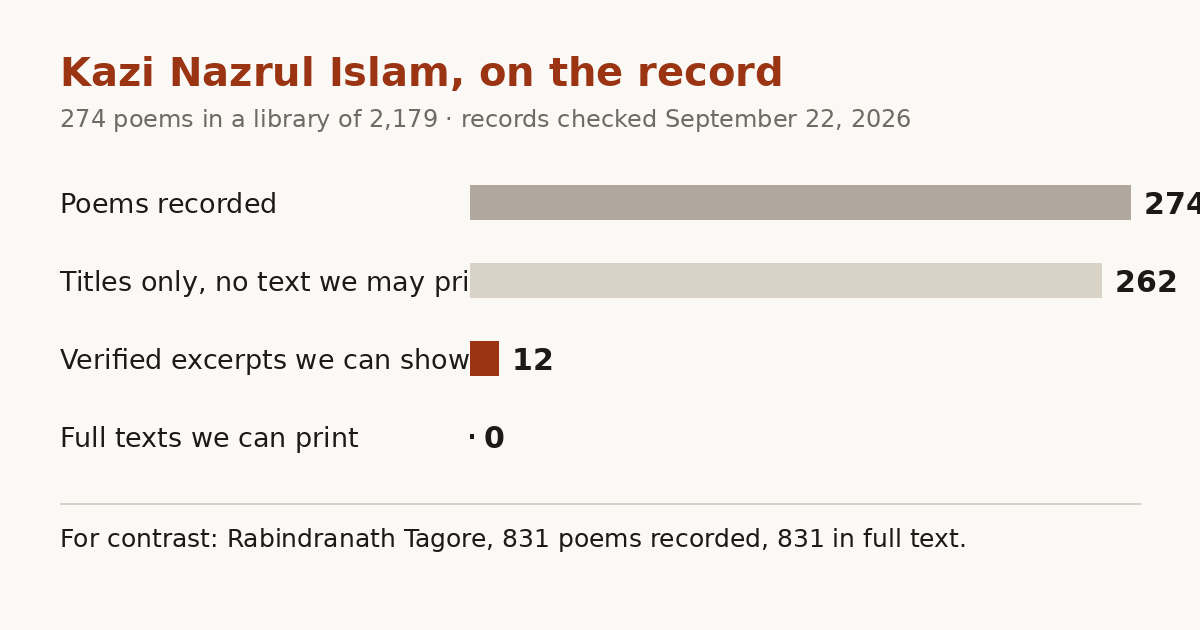
Our library holds 2,179 Bengali poems, each record checked on September 22, 2026. Kazi Nazrul Islam is the second most recorded poet in it, with 274 poems, behind only Rabindranath Tagore at 831. The 274 titles span 15 of his named collections, from Agnibina and Bisher Banshi to Chhayanat, which alone contributes 51 of them. It is a serious map of the work. But here is the count this article turns on: of those 274 poems, the number you can read in full on this site is zero. Twelve carry a short verified excerpt, a first stanza of at most four lines, marked as partial. The other 262 are titles only, real poems verified against real tables of contents, with the text deliberately left blank. Among the five poets with the most poems in the library, Nazrul and Jasimuddin (109 poems, five excerpts, no full texts) are the two in this position; Tagore’s 831 are all readable, and so are the full shelves of Jibanananda Das (132) and Sukanta Bhattacharya (110). The 12 excerpts do include the title readers search for above all others, Bidrohi (The Rebel), and Samyabadi (Song of Equality). For the poems themselves, their fire and their stories, our guide to kazi nazrul kobita is the reading list; this article is about the record underneath it.
Why only 12: the life plus 60 rule
The reason is not neglect, and it is not a licensing fee we declined to pay. Copyright in Bangladesh, as this library applies it, runs for the poet’s life plus 60 years. Nazrul died in August 1976, so his work remains in copyright in Bangladesh until 2037. Our house rule follows from that, and it is the same rule the whole library is built on. A poet who died in or before 1965 can be printed in full, and we transcribe those texts from public sources such as Bengali Wikisource. A poet still in copyright receives at most a verified first stanza, marked partial, never more. And where even a first stanza cannot be verified against a reliable source, the poem stays a title rather than a guess. Applied across 2,179 records, the policy gives the library its shape: 1,320 full texts by exactly 12 poets, 117 marked excerpts, and 742 titles without text. That is why our beginner’s guide to Rabindranath kobita can honestly promise whole poems, Tagore died in 1941, while no honest library in Bangladesh can promise you a whole Nazrul before 2037.
The Card Maker has to say no, too
The same rule runs the Kobita Card Maker. Its built-in library draws only on the 1,320 full texts, by the 12 public domain poets, so it contains no Nazrul lines at all, and we would rather tell you that plainly than let you discover it mid-card. That absence is the rule working, not a gap on a roadmap. What you can do this week: card a Tagore or Jibanananda line for the Nazrul lover in your life, or paste lines of your own and let the maker set them in the same moods and sizes. And when 2037 arrives, the shelf changes overnight, in this library and in the maker alike.
After October 31
The exhibition closes tomorrow, but Nazrul Year runs until May 25, 2027, with programmes continuing across the country, so October 31 is a deadline for one gallery, not for the observance. The map of the work stays here either way: 274 titles, 12 excerpts you can read today, and a year, 2037, that will quietly turn the most guarded shelf in Bengali poetry into an open one. If you go tomorrow, go for the objects, the sweater, the plates, the certificate, the bed. Then come home and read what can be read, starting with the 12.
How we counted: every library figure in this article comes from our poem records, verified on September 22, 2026 and recomputed for this piece. Exhibition details come from the museum coverage published October 24 to 26, 2026, rechecked on October 30, 2026. No line of Nazrul’s poetry is quoted in this article, only titles, by the same copyright policy the article describes.